|
|
|
------------
The Presentations
----------------------------------------------------------------
|
|
|
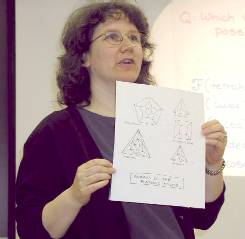
Prof. Lauren Rose |
|
|
How Many Faces Can a Polyhedron Have? There is well-known formula of
Euler which states that if V, E, and F are the number of vertices, edges, and
faces of a polyhedron, then V - E + F = 2. What about the converse of this
statement? Given any 3 positive integers, V, E, and F satisfying the equation
V - E + F = 2, can we construct a polyhedron with V vertices, E edges, and F
faces? We will answer this question and more, providing a complete
characterization of all possible triples (V, E, F) corresponding to a three
dimensional polyhedron. We will then explore what this all means in
dimensions four and higher. |
|
|
|
|
|
Prof. Robert McGrail |
|
|
(Almost) Quicksort in Linear Time In this talk we consider
alterations of the standard quicksort algorithm in which the pivot is some
measure of central tendency, in particular mean and midrange. Under certain
circumstances, these new algorithms run in linear time with respect to the
length of the array.
|
|
|
|
|
|
Arika Garcia (junior) |
|
|
Planar Graphs Leonhard Euler’s contributions
to mathematics covered a wide range of topics including calculus, geometry,
and number theory. One of Euler’s well-known discoveries was that all planar
representations of a graph divide the plane into the same number of regions.
He proved this discovery by uncovering a relationship to the number of
vertices, the number of regions, and the number of edges in a planar graph.
His formula can also be used to describe the relationship between the number
of vertices, faces, and edges of any polyhedron. I will be presenting the
proof to the following Theorem: Euler’s Formula: Let G be a connected planar
simple graph with e edges,and v vertices. Let r be the number of regions in a
planar representation of G. Then r = e – v + 2. |
|
|
|
|
|
Monica Elkinton (junior) |
|
|
Weird Dice: A Fun Application of Unique Factorization When rolling a pair of dice,
we see that the probability of rolling a total of 7 is 1/6 (because there are
six ways to get a sum of 7 and 36 possible rolls). Are there any other sets
of positive integers with which we can label a pair of dice, that will yield
the same probabilities of possible rolls 2-12 as a standard pair? For
example, what other sets of numbers on die faces will still give us a 1/6
chance of rolling a sum of 7? Using polynomial representations and Unique
Factorization, we will show that non-standard Sicherman Dice are the only
6-sided solution. |
|
|
|
|
|
Sean Callanan (junior) |
|
|
Isometric Subgraphs of Hypercubes Hypercube graphs are useful
in computer science as descriptions of the structure of multiprocessor and
parallel computers. They are thought to be very versatile because they can
efficiently simulate many other structures. But how versatile are they really
- which other classes of structures can we simulate? This problem is best tackled with
the tools of graph theory. We explore the tools developed for the
identification of graphs "isometrically" embeddable into hypercubes
- that is, graphs whose vertices may be mapped to vertices on some hypercube
graph, with the distance between two vertices in the bypercube being equal to
that in the original graph. Knowledge of the definition of a graph will be
assumed. |
|
|
|
|
|
Timothy Goldberg (senior) |
|
|
Combinatorial Laplacian Spectra of Simplicial Complexes For each non-negative integer
dimension, the set of chains over R of a simplicial complex forms a
finite-dimensional vector space over R. In each dimension the Combinatorial
Laplacian is a linear operator on this vector space of chains of the complex.
This Laplacian for simplicial complexes is a generalization to higher
dimensions of the Combinatorial Laplacian Matrix studied in graph theory. I
will discuss relationships between various families of simplicial complexes
and the eigenvalues of their Laplacians, called their Laplacian Spectra. |
|
|