|
4th Annual Research Symposium
|
|
|
|
Bard College |
|
Participants |
|
|
|
|
|
|
Imran Ahmed Advisor: Mark Halsey
|
|
Does the out-degree of a vertex double when an oriented graph is
squared? The conjecture that in every oriented graph,
there exists a vertex whose out-degree at least doubles when the oriented
graph is squared, is studied. The conjecture is first proved for some basic
classes of oriented graphs such as paths and cycles. Then the conjecture is
modified to investigate whether a vertex with minimum out-degree always
doubles in an oriented graph. The modified conjecture is then proved for
oriented graphs with girth greater than or equal to 4, which implies that the
modified conjecture is proved for bipartite graphs and split graphs. Counter
examples are shown for the modified conjecture in case of split graphs. |
|
|
Sean Callanan Advisor: Mark Halsey
|
|
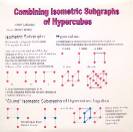
Combining Isometric Subgraphs of Hypercubes We define a distance function
d on pairs of vertices of a graph by the number of edges one must traverse to
get from the first vertex to the second. We say a graph G is an isometric
subgraph of a graph H if the vertices of G may be mapped to a subset of the
vertices of H such that the distance between a pair of vertices in G is the
same as the distance between the maps of the two vertices, in H. We consider
how one may combine isometric subgraphs of hypercubes, where hypercubes are
defined as follows: A zero-dimensional hypercube is a single vertex, and an
n-dimensional hypercube is the result of the cartesian product of an
(n-1)-dimensional hypercube with the complete graph on two vertices. |
|
|
Timothy E.
Goldberg Advisor: Ethan Bloch
|
|
Combinatorial Laplacians of Simplicial Complexes In this paper, we study the combinatorial Laplacian operator on the vector space of oriented chains over the real numbers of a finite simplicial complex. We develop an easy method of computing the matrix of this operator from the adjacencies of simplices in the simplicial complex, and then apply this and results from linear algebra and simplicial homology to study properties of the Laplacian operator and its spectrum. We examine and explore connections between the combinatorial structure of simplicial complexes and their Laplacian spectra. Specific examples studied include certain classes of graphs and higher dimensional simplicial complexes, in particular cones of simplicial complexes, especially simplicial cones of dimension 2.
|
|
|
Laura Gordon Advisor: Felicia Keesing
|
|
Effects of Forest Fragmentation on Carnivore Diversity in
Dutchess County, New York The effects of forest fragmentation on biological diversity is a topic of growing interest. In the eastern United States, increased urban and suburban sprawl is carving up once continuous hardwood forests into isolated forest patches. Most studies on the effects of forest fragmentation have focused on rodents, songbirds, and arthropods. However, a recent study in central Illinois focused on mammal diversity and found that small patches had lower diversity of mammal species than did large patches. The effects of forest fragmentation on carnivore diversity have not been previously studied in the eastern U.S., though carnivores are a critical component of forest communities. A recent study demonstrated that fragmentation poses a potential health risk due to high prevalence of disease-bearing ticks in small forest patches, presumably because these small patches have elevated densities of the rodent which is the most competent reservoir for Lyme disease. Understanding how forest fragmentation affects carnivores (the primary predators of rodents) may help to explain the unusually high densities of white footed mice and therefore the increased Lyme disease risk in small patches. I surveyed 11 forest fragments ranging in size from 0.2 ha to 5816 ha. I found a positive log-linear relationship between carnivore species richness and patch area (R²= 0.62, P= 0.004). Indicating that carnivore species richness is significantly affected by forest patch size. The lack of carnivore species within small sites suggests that there may be little or no predator control of rodent species within these patches. This may explain the high densities of white-footed mice, and subsequently the high prevalence of Lyme disease risk in small forest patches. My results suggest that limiting forest fragmentation may help to curtail Lyme disease risk by providing habitats which encourage carnivore activity. |
|
|
Ian McBee Advisor: Hilton Weiss
|
|
Sequential Cope-Cope rearrangement of
4-vinyl-1,7-octadiene. 1,5,9-decatriene was heated to produce 4-vinyl-1,7-octadiene in an equilibrium Cope rearrangement. The presence of equilibrium concentrations of 4-vinyl-1,7-octadiene indicates that it has undergone a degenerate sequential Cope-Cope rearrangement. This rearrangement proceeds by a concerted [3,3]-sigmatropic shift, rather than the diradical mechanism. |
|
|
Rossy Peralta Advisor: John B. Ferguson
|
|
Partial characterization of the gene for NAD+-dependent
malate dehydrogenase from Tetrahymena
thermophila In Tetrahahymena thermophila the interconversion of L-malate and oxalacetate is catalyzed
by NAD+-dependent malate dehydrogenase. The T. thermophila gene
for malate dehydrogenase was characterized by amplifying portions of it with
the polymerase chain reaction, using primers based on available expressed
sequence tags. This approach
successfully amplified the majority of the malate dehydrogenase gene, and sequence
analysis revealed the presence of two introns. A preliminary phylogenetic analysis of the malate dehydrogenase
gene is presented. |
|
|
Jeffrey Rawson Advisor: Hilton Weiss
|
|
An Investigation of Carbanion Chemistry: Synthesis and Study of 1,4 diphenyl
2-butene-1-one In the interest of studying
conjugated carbanion systems, 1,4 diphenyl 2-butene-1-one was
synthesized. The properties of this
compound and its anion were examined in both laboratory experiments and in
computational models. Of particular
interest was the distribution of negative charge within the anion, and the
relationship between this distribution and the relative reactivity of
specific sites in the molecule towards electrophiles. Chemical shifts from 13C NMR spectra were
correlated with charge density for this purpose. Results and spectroscopic data are provided in the text. |
|
|
Gregory Roman Advisors: Simeen Sattar,
Burton Brody
|
|
Experimental and Theoretical Studies of the Photo-induced
Isomerization of Mercury (II) Dithizonate Using Pump Probe Spectroscopy Pump probe spectroscopy was
used to determine the relationship between the photochromic isomerization
rate of mercury dithizonate, Hg(HDz)2, and the pKa, polarizability, and
dielectric constant of primary alcohol and aprotic solvents. The results
allowed a qualitative molecular approach to describe the rates of the back
reaction. By using deuterated solvents it was possible to identify important
proton transfers that occur in the isomerization of Hg(HDz)2, which elucidate
the mechanism pathway. In addition to photochromic isomerization, a new
series of reactions involving acids and bases was discovered. These reactions
create unstable molecules that return to the starting Hg(HDz)2 over time.
Theoretical calculations using semi-empirical methods were used to predict
molecular orbital shifts, color changes, and the energies of transition
states and isomers. HOMO and LUMO energy differences were correlated with the
wavelength of maximum absorbance of both the stable ground state isomer and
the metastable ground state isomer. |
|
|
Katheryn Ross Advisor: Matthew Deady
|
|
A Study of the Duffing Oscillator with Discontinuous
Input Experimental and Computer Modeling A steel wire carrying an alternating current which sits
between the poles of a magnet will vibrate due to the magnetic force on the current. The dynamics of these vibrations can be
described by the Duffing equation, which has been extensively studied with
continuous driving functions. This
study explores through computer modeling and experimentation how the Duffing
oscillator behaves with a discontinuous driving function, specifically a
sawtooth function. From computer
modeling, it appears that there are distinct differences in the way a Duffing
oscillator will behave when it is driven with a discontinuous function than
when driven by a continuous function.
The experimental apparatus was inadequate to demonstrate a difference
in string oscillation for continuous and discontinuous driving functions. |
|
|
Sarah Shapiro Advisor:
Michael Tibbetts
|
|
The Evolution of HIV-1 gp120 Envelope Glycoprotein to
Virulence in a Macaque Model Infection of Rhesus macaques
with chimeric simian-human immunodeficiency virus (SHIV) provides a model to
study the role of the HIV-1 envelope in infection. Two animals were inoculated with a molecular clone, SHIVSF162,
followed by sequential blood and bone marrow transfusions into three further
pairs of animals. Two of the 8
animals, T353 and T378, from passages three and four respectively, progressed
to simian AIDS (SAIDS). Finally, at
20 weeks post infection, blood and bone marrow from T353 were used to
inoculate one more animal, RO61, which resulted in rapid progression to
disease. Envelope genes from these
RO61 viruses showed conserved amino acid changes, which were termed the
pathogenic variants. We therefore
took a series of samples from one animal that succumbed to SAIDS, animal
T353, in order to investigate in detail the evolution of the envelope gene,
specifically gp120. The goal is to
determine which of the conserved amino acid mutations arose due to selective
advantage. It seems that five
mutations, located in the V2, C2, V3 and C3 regions of gp120, give the virus
a selective advantage, based on likelihood of the mutations occurring by
chance, and where the mutations appear in the structure of gp120. |
|
|
Jaren Smith Advisor: Lauren Rose
|
|
Hilbert Sequences of Monomial Ideals In this project, we investigate
the Hilbert function of polynomial rings and various monomial ideals in these
rings. We then use the results of
these functions to form something called a Hilbert sequence. Our ultimate goal is to characterize all
of the Hilbert sequences that arise using different polynomial rings and
monomial ideals. In particular, we
find the types of sequences that have a finite number of non-zero entries and
a group of sequences that are guaranteed to be symmetric. Finally, we are able to describe all possible
Hilbert sequences for every monomial ideal in the polynomial rings in either
one or two variables. As it turns
out, these are also all of the possible Hilbert sequences for all homogeneous
ideals in the same polynomial rings.
|
|
|
Jamie Twaite Advisor: Michael Tibbetts
|
|
Characterizing Kaps:
An Examination of a Karyopherin/Substrate Relationship Nucleocytoplasmic transport is
the transport of large macromolecules between the cytoplasm and the
nucleoplasm via the Nuclear Pore Complex.
The mechanism of transport, including the individual proteins and
structures involved, is fairly well characterized, however particular aspects
are still not well understood. The
primary components of this transport cycle are the Karyopherins (Kaps), the proteins
responsible for binding substrates and carrying them through the Nuclear Pore
Complex. The exact nature of the
Kap/Substrate relationship is not well understood. To further examine Kap/Substrate binding, experiments were
undertaken to identify the Kap responsible for binding and importing the
yeast protein TIF6 into the nucleus.
A plasmid containing a GFP/TIF6 fusion was transformed into 13 yeast
strains, each with a different Kap gene removed from the genome. Transformants were then examined for signs
of protein mislocalization by comparison of GFP fluorescence in the knockout
strains to that of wild type cells.
No mislocalization was observed, indicating that TIF6 may be
transported by the Classical pathway or by overlapping pathways, so that if
the Kap that primarily transports TIF6 is absent, another Kap will transport
TIF6 instead. |
|
|
Lava Yadav Advisor: Mark Halsey
|
|
Chromatic Number of Competition Graphs of Split Graphs The
chromatic number of the competition graph of a split graph is studied. In
particular we investigate split graphs where a bound has been put on the
degree of the vertices in the independent set of the split graph. We use the
clique number to obtain results on the chromatic number of the competition
graph. Further, we study the relationship between the arrangements of maximal cliques in the
competition graphs and their chromatic numbers. |














|
Participants |
|
|
|
|
|